The Best Waterproof Humidity Sensor Arduino of 2025 – Reviewed and Top Rated
After hours researching and comparing all models on the market, we find out the Best Waterproof Humidity Sensor Arduino of 2025. Check our ranking below.
2,960 (random num) Reviews Scanned

- Sealed Waterproof Design: IP67-rated emitter enclosure for outdoor use in rain/humidity (non-submersible).
- Precision Distance Measurement: 25cm-400cm range with 0.5cm resolution at 40kHz frequency and 70° detection angle.
- Low-Power Operation: 5V DC supply with 5mA static/30mA active current consumption.
- Multi-Mode Configuration: Adjustable parameters for diverse applications: reversing sensors/security systems/industrial control.
- Simplified Interface: Trig (RX)/Echo (TX) pins enable distance calculation: (high-level duration × 340m/s) ÷ 2.

- The pluggable DS18B20 temperature probe sensor is easy to plug and can be used in a variety of environments.
- With pull-up resistor on board, the adapter module can be connected directly to most microcontrollers and it is widely used in temperature monitoring for fish tanks, equipment, machinery, greenhouses.
- Widely applications: thermostatic controls, industrial systems, consumer products, thermometers, any thermally sensitive system, etc.
- Working voltage: 3.3 ~ 5VDC, Output leads: yellow (DATA), red (VCC), black (GND)
- Measuring range: -55 ~ 125 ℃, Lead can only withstand a maximum temperature of 85 degrees


- 【Version】This capacitive analog soil moisture sensor is V1.2
- 【Voltage】Working voltage: 3.3~5.5 VDC, output voltage: 0~3.0 VDC
- 【Interface】Interface: PH2.54-3P, Pin: Analog signal output, GND, VCC
- 【Feature】Capacitive humidity sensor has good linearity, good repeatability, small hysteresis, fast response, small size, and can be used at - 10 ℃ - 60 ℃ humidity environment
- 【Comparision】This capacitive soil humidity sensor is different from most of the resistive sensors. It uses the capacitive sensing principle to detect soil humidity, avoiding the problem that the resistive sensor is easily corroded, and greatly extending its working life.
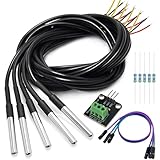
- DS18B20 Temperature Sensor is designed for underwater use, capable of operating in wet or moist environments without being damaged by water or moisture. Provides from 9-bit to 12-bit Celsius temperature measurements
- Supply voltage:3.0V ~ 5.25V; Wiring: Red(VCC), Yellow(Data), Black(GND); Length: 3.3ft/1 m;
- Operating temperature range:-55 ℃ to +125 ℃ (-67 ℉ to +257 ℉)
- Adapter module is equipped with a pull-up resistor, and directly connects to the GPIO of the Raspberry Pi without an external resistor Use this adapter module kit to simplify connecting the waterproof temperature sensor to your project
- Packing list:5pcs DS18B20 Temperature Sensor and 1pcs Adapter module and 3pcs Dupont wire and 5pcs 4.7k Metal film resistor

- Premium materials: Stainless-steel probe with waterproof seal, approx. 6–7 mm Ø and 26–45 mm length, corrosion-resistant to reduce short-circuit risk. Supplied with ≈1 m PVC/PTFE-sheathed lead (cable is not fully waterproof or flame-retardant); cable maximum continuous temperature ≈85 °C. For long-term submersion or humid use, seal the cable joint with heat-shrink, silicone, or epoxy.
- Temperature specs: Range −55 °C to +125 °C (−67 °F to +257 °F); typical accuracy ±0.5 °C from −10 °C to +85 °C. Resolution selectable 9/10/11/12 bits (12-bit LSB = 0.0625 °C); conversion time up to ~750 ms at 12-bit (9≈94 ms, 10≈188 ms, 11≈375 ms). Supports user-programmable non-volatile upper/lower alarms (TH/TL) and alarm-search. Operates on a 3.0–5.5 V supply and supports both external-power and parasitic-power modes (external VDD recommended for stable long-distance or multi-sensor installations).
- Package & wiring colors: Includes sensor model DS18B20 ×4, plugable terminal adapters (e.g., model DFR0055) ×4, and 1m sensor cables (e.g., model FIT0011) ×4. Sensor leads: green = DATA, red = VCC, yellow = GND. Adapters may be wired in two variants—check before wiring: Type A: red=VCC, black=GND, yellow=DATA; Type B: red=VCC, yellow=GND, green=DATA. Verify mappings or test with a multimeter before powering.
- 1-Wire bus notes: Uses the 1-Wire digital bus; each sensor has a unique 64-bit ROM ID for multi-point management. Use a 4.7 kΩ pull-up from DATA to VCC; for long runs use shielded cable, proper grounding and waterproofed joints. Parasitic power is supported, but for critical or long-distance installations use separate VDD for stability.
- Quick installation: Insert each probe into a plugable terminal adapter (e.g., DFR0055) and connect to a host device (microcontrollers or single-board computers). Wire VCC (3.0–5.5 V) → GND → DATA (1-Wire) with a 4.7 kΩ pull-up on DATA, and use standard 1-Wire libraries (for example, the DallasTemperature library) to read values. Calibrate with a short water bath or known temperature before deployment and seal all connections.
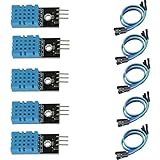
- DHT11 digital temperature and humidity sensor is a digital signal output with a calibrated temperature and humidity combined sensor.
- It uses a dedicated digital modules and acquisition of temperature and humidity sensor technology to ensure that products with high reliability and excellent long term stability.
- Sensor consists of a resistive element and a sense of wet NTC temperature measurement devices, and with a high-performance 8-bit microcontroller connected.
- The product has excellent quality, fast response, anti-interference ability, high cost and other advantages.
- The single-wire wiring scheme makes it easy to be integrated to other applications.And the simple communication protocol greatly reduces the programming effort required.
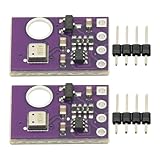
- 2pcs AHT30 High Precision Digital Temperature and Humidity Sensor Measurement Module I2C IIC Communication
- Digital temperature and humidity sensor, I2C master output, support simultaneous online access to multiple I2C electronic devices or modules.
- DC 2.0V-5V voltage can be used, voltage is easy to adapt, low power consumption, simple circuit, accurate temperature measurement point.
- Stable and fast transmission speed.
- 4P test line connection is adopted, which is convenient for users to use it quickly. Product parameters:

- Function: A simple humidity sensor for detecting soil moisture.
- Output: High level output when soil is dry, low level otherwise.
- Application: Used to make automatic watering devices for easy plant garden management.
- Output Modes: Dual output mode with simple digital output and more accurate analog output.
- Features: Adjustable sensitivity (digital potentiometer adjusts digitally) and stable operation using LM393 comparator.

- Package Quantity:4 Pcs DS18B20 Temperature Sensor Waterproof, Stainless Steel Digital Probe 1M Cable.
- Operating Voltage: 3.0V–5.5V ( Compatible Arduino/Raspberry Pi /ESP32, ESP8266 ), Temperature Range: -55°C to +125°C (±0.5°C accuracy between -10°C~85°C), High-temperature resistant cable (-55°C~125°C) with anti-kink design.
- Plug-and-Play: 1-Wire bus protocol supports multi-sensor parallel connection with a single data line. TIP: Black lead goes to ground. Red lead goes to 3.3vdc and yellow is your data line.
- Usage Notes: Wiring-Requires 4.7KΩ pull-up resistor (some boards have built-in support); Only the probe is waterproof; cable joints need insulation.
- Wide Application:Process temperature monitoring /Air conditioning monitoring /Hatching temperature control / Temperature measurement of aquaculture /Temperature monitoring in greenhouse /domestic refrigerator /Cold storage temperature monitoring /Telecommunication room monitoring/ Warehouse temperature monitoring/ environmental monitoring, etc.
Last update on 2026-04-04 / Affiliate links / Images from Amazon Product Advertising API
How Do You Buy The Best Waterproof Humidity Sensor Arduino?
Do you get stressed out thinking about shopping for a great Waterproof Humidity Sensor Arduino? Do doubts keep creeping into your mind? We understand, because we’ve already gone through the whole process of researching Waterproof Humidity Sensor Arduino, which is why we have assembled a comprehensive list of the greatest Waterproof Humidity Sensor Arduino available in the current market. We’ve also come up with a list of questions that you probably have yourself.
We’ve done the best we can with our thoughts and recommendations, but it’s still crucial that you do thorough research on your own for Waterproof Humidity Sensor Arduino that you consider buying. Your questions might include the following:
- Is it worth buying an Waterproof Humidity Sensor Arduino?
- What benefits are there with buying an Waterproof Humidity Sensor Arduino?
- What factors deserve consideration when shopping for an effective Waterproof Humidity Sensor Arduino?
- Why is it crucial to invest in any Waterproof Humidity Sensor Arduino, much less the best one?
- Which Waterproof Humidity Sensor Arduino are good in the current market?
- Where can you find information like this about Waterproof Humidity Sensor Arduino?
We’re convinced that you likely have far more questions than just these regarding Waterproof Humidity Sensor Arduino, and the only real way to satisfy your need for knowledge is to get information from as many reputable online sources as you possibly can.
Potential sources can include buying guides for Waterproof Humidity Sensor Arduino, rating websites, word-of-mouth testimonials, online forums, and product reviews. Thorough and mindful research is crucial to making sure you get your hands on the best-possible Waterproof Humidity Sensor Arduino. Make sure that you are only using trustworthy and credible websites and sources.
We provide an Waterproof Humidity Sensor Arduino buying guide, and the information is totally objective and authentic. We employ both AI and big data in proofreading the collected information. How did we create this buying guide? We did it using a custom-created selection of algorithms that lets us manifest a top-10 list of the best available Waterproof Humidity Sensor Arduino currently available on the market.
This technology we use to assemble our list depends on a variety of factors, including but not limited to the following:
- Brand Value: Every brand of Waterproof Humidity Sensor Arduino has a value all its own. Most brands offer some sort of unique selling proposition that’s supposed to bring something different to the table than their competitors.
- Features: What bells and whistles matter for an Waterproof Humidity Sensor Arduino?
- Specifications: How powerful they are can be measured.
- Product Value: This simply is how much bang for the buck you get from your Waterproof Humidity Sensor Arduino.
- Customer Ratings: Number ratings grade Waterproof Humidity Sensor Arduino objectively.
- Customer Reviews: Closely related to ratings, these paragraphs give you first-hand and detailed information from real-world users about their Waterproof Humidity Sensor Arduino.
- Product Quality: You don’t always get what you pay for with an Waterproof Humidity Sensor Arduino, sometimes less, and sometimes more.
- Product Reliability: How sturdy and durable an Waterproof Humidity Sensor Arduino is should be an indication of how long it will work out for you.
We always remember that maintaining Waterproof Humidity Sensor Arduino information to stay current is a top priority, which is why we are constantly updating our websites. Learn more about us using online sources.
If you think that anything we present here regarding Waterproof Humidity Sensor Arduino is irrelevant, incorrect, misleading, or erroneous, then please let us know promptly! We’re here for you all the time. Contact us here. Or You can read more about us to see our vision.
FAQ:
Q: What is the best temperature sensor for Arduino?
A: Using A TMP36 Temperature Sensor With Arduino. The TMP36 temperature sensor is an easy way to measure temperature using an Arduino! The sensor can measure a fairly wide range of temperature (-50°C to 125°C), is fairly precise (0.1°C resolution), and is very low cost, making it a popular choice.
Q: What is the type of sensor that measures humidity?
A: Technically, the device used to measure the humidity of the atmosphere is called Hygrometer. Humidity Sensors or Hygrometers can be classified based on the type of humidity it is used for measuring i.e. Absolute Humidity (AH) sensors or Relative Humidity (RH) sensors.
Q: What is the use of humidity sensor?
A: A humidity sensor, also called a hygrometer, measures and regularly reports the relative humidity in the air. They may be used in homes for people with illnesses affected by humidity; as part of home heating, ventilating, and air conditioning (HVAC) systems; and in humidors or wine cellars.
Q: Do the remote sensors measure humidity?
A: Sensor Facts The sensors include a motion detector to tell the ecobee which parts of your house are active. They also include a temperature sensor so it can figure out the best way to keep you comfortable. The remote sensors do not include a humidity sensor, but the ecobee does.
Related Post:
- temp and humidity sensor
- Hsu-07 Humidity Sensor
- Aqara Temperature Humidity Sensor
- temperature and humidity controller
- humidity and temperature controller
- Digital Temperature And Humidity Controller
- Luxe Style Infusion Anti Humidity Spray
- Willhi Humidity Controller
- Humidity Controller Switch
- temperature and humidity gauge