
The Best French Flintlock Pistol of 2025 – Reviewed and Top Rated
After hours researching and comparing all models on the market, we find out the Best French Flintlock Pistol of 2025. Check our ranking below.
2,295 Reviews Scanned

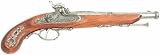
- 18th Century Style: This pistol has a classic 18th century style with brass finish and wood construction.
- Single Barrel Design: Features a single barrel design for easy handling and accuracy.
- Flintlock Mechanism: Uses a flintlock mechanism for reliable ignition and smooth operation.
- Non-Locking Bolt: The bolt does not lock back for semi-automatic or automatic fire.
- Unsuitable for Children: This pistol is not suitable for children under 14 years old due to its sharp edges and small parts.


- 14.6 inches (37 cm) total length 515 g
- old gun (France 19th century) reissue gun
- Material: Zinc alloy and wood
- bullet launcher (imitation gun) This is not an air gun, airsoft gun, or gas gun

- Package length: 38.354 cm
- Package width: 12.7 cm
- Package height: 5.588 cm
- Product Type: SPORTING GOODS
- Model Number: FD1014G
- Country Of Origin: Spain
Last update on 2025-09-08 / Affiliate links / Product Titles, Images, Descriptions from Amazon Product Advertising API
How Do You Buy The Best French Flintlock Pistol?
Do you get stressed out thinking about shopping for a great French Flintlock Pistol? Do doubts keep creeping into your mind? We understand, because we’ve already gone through the whole process of researching French Flintlock Pistol, which is why we have assembled a comprehensive list of the greatest French Flintlock Pistol available in the current market. We’ve also come up with a list of questions that you probably have yourself.
We’ve done the best we can with our thoughts and recommendations, but it’s still crucial that you do thorough research on your own for French Flintlock Pistol that you consider buying. Your questions might include the following:
- Is it worth buying an French Flintlock Pistol?
- What benefits are there with buying an French Flintlock Pistol?
- What factors deserve consideration when shopping for an effective French Flintlock Pistol?
- Why is it crucial to invest in any French Flintlock Pistol, much less the best one?
- Which French Flintlock Pistol are good in the current market?
- Where can you find information like this about French Flintlock Pistol?
We’re convinced that you likely have far more questions than just these regarding French Flintlock Pistol, and the only real way to satisfy your need for knowledge is to get information from as many reputable online sources as you possibly can.
Potential sources can include buying guides for French Flintlock Pistol, rating websites, word-of-mouth testimonials, online forums, and product reviews. Thorough and mindful research is crucial to making sure you get your hands on the best-possible French Flintlock Pistol. Make sure that you are only using trustworthy and credible websites and sources.
We provide an French Flintlock Pistol buying guide, and the information is totally objective and authentic. We employ both AI and big data in proofreading the collected information. How did we create this buying guide? We did it using a custom-created selection of algorithms that lets us manifest a top-10 list of the best available French Flintlock Pistol currently available on the market.
This technology we use to assemble our list depends on a variety of factors, including but not limited to the following:
- Brand Value: Every brand of French Flintlock Pistol has a value all its own. Most brands offer some sort of unique selling proposition that’s supposed to bring something different to the table than their competitors.
- Features: What bells and whistles matter for an French Flintlock Pistol?
- Specifications: How powerful they are can be measured.
- Product Value: This simply is how much bang for the buck you get from your French Flintlock Pistol.
- Customer Ratings: Number ratings grade French Flintlock Pistol objectively.
- Customer Reviews: Closely related to ratings, these paragraphs give you first-hand and detailed information from real-world users about their French Flintlock Pistol.
- Product Quality: You don’t always get what you pay for with an French Flintlock Pistol, sometimes less, and sometimes more.
- Product Reliability: How sturdy and durable an French Flintlock Pistol is should be an indication of how long it will work out for you.
We always remember that maintaining French Flintlock Pistol information to stay current is a top priority, which is why we are constantly updating our websites. Learn more about us using online sources.
If you think that anything we present here regarding French Flintlock Pistol is irrelevant, incorrect, misleading, or erroneous, then please let us know promptly! We’re here for you all the time. Contact us here. Or You can read more about us to see our vision.
FAQ:
Q: Who was the inventor of the flintlock gun?
A: The Flintlock, sometimes called the French Lock was the last in the line of locks based on the flint. It was developed in France about 1615 and Marin le Bourgeoys was given credit for designing it. The basic design became the standard for flintlocks and quickly replaced older firing mechanisms throughout Europe.
Q: When was the flintlock musket used in Europe?
A: Flintlock muskets were the mainstay of European armies between 1660 and 1840. It was replaced with the percussion cap system. The first of the flint based locks was the Snaphaunce, the English Lock, the Dog Lock, the Miquelet Lock, then finally the French or Flintlock.
Q: What kind of condition does a flintlock gun have?
A: In overall good+ “Attic Untouched” original flintlock condition with surface oxidation, signs of use and wear. The barrels with dark, rust-patinated surfaces, scattered patches of discoloration/fine pitting and very good touch-holes and bores.
Q: What kind of locks did the pirates use?
A: It was replaced with the percussion cap system. The first of the flint based locks was the Snaphaunce, the English Lock, the Dog Lock, the Miquelet Lock, then finally the French or Flintlock. Pirate Fashion is the only place in the world were you can get all type of locks from the matchlock to the percussion cap.