
20 Best Tuner For Cello of 2025 – Romance University
After hours researching and comparing all models on the market, Romance University finds out the Best Tuner For Cello of 2025. Check our ranking below.
2,731 Reviews Scanned
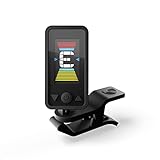
- EXTREME ACCURACY - The Eclipse Cello, Bass Tuner features an extremely accurate piezo transducer that picks up an instrument's vibration rather than sound. A wide calibration range (430-450Hz) guarantees precise performance.
- CELLO TUNER CLIP ON - Features a non-marring, lever-lock clamp that holds the tuner securely to the instrument while allowing easy application and removal.
- LCD SCREEN - Tri-color reversible backlit LCD screen makes it easy to tune in dark environments
- CLIP ON TUNER FOR - Cellos and Basses. Tune both instruments with confidence, ease and accuracy.
- D’ADDARIO ACCESSORIES - For over 20 years, D’Addario Accessories (formerly Planet Waves) has been leading the industry in innovative and problem-solving products that serve musicians worldwide.

- FAST, ACCURATE TUNING - Tune quickly and accurately in noisy environments with a high-performance piezo pickup that is optimized for a wide range of high and low frequencies.
- RECHARGEABLE TUNER - 24 hours of tuning time per charge (USB-C cable included). Auto power-off maximizes use time per charge
- CLIP ON TUNER - For best accuracy on cello and bass, attach the tuner to the side of the bridge with the lower strings.
- ADJUSTABLE LED SCREEN - Extra bright, full-color LED with 360-degree adjustability for the perfect viewing angle and screen clarity in any lighting
- D’ADDARIO ACCESSORIES - For over 20 years, D’Addario Accessories (formerly Planet Waves) has been leading the industry in innovative and problem-solving products that serve musicians worldwide.

- Compact 3-in-1 Design: Combines a digital metronome, chromatic tuner, and tone generator in one pocket-sized unit. Easy to carry in your instrument case—perfect for daily practice, music lessons and performances
- Versatile Digital Metronome: Adjustable tempo from 30–260 BPM, 10 beat patterns (0–9), and 8 rhythm styles help you improve timing and groove across multiple musical genres
- Fast, Precise Tuning for Multiple Instruments: Supports A0–C8 tuning range, A4 calibration (430–450Hz), and ±0.5 cent accuracy. Ideal for guitar, bass, violin, ukulele, mandolin, flute, trumpet, and other string or wind instruments. (Note: This AMT-560 tuner is not suitable for piano tuning. )
- Clear Backlit Display & Multi-Sense Feedback: The large LCD screen with 45° angled design ensures perfect readability in any light. Combined with bright LED lights and clear sounds, it provides intuitive visual and auditory rhythm cues. Adjustable volume and headphone jack allow silent or loud practice anywhere
- Practical Tone Generator for Ear Training: Quickly switch modes to generate precise reference tones. An essential tool for developing intonation, perfect pitch, and meeting specific rehearsal or performance requirements

- Easily tune any instrument you can clip to with fully chromatic, one button operation
- Built in tuning presets for guitar, bass, violin, ukulele
- Easy to read blue backlit LCD screen while tuning, turns green when the note is in tune
- A Calibration: 440 Hz - Tuning range: A0(27.5Hz) - B7(4186Hz)
- Powered by 3V Lithium battery (CR2032) Included with auto-off feature

- Rechargeable – No batteries to buy or change for convenience and eco-friendliness!
- BRIGHT FULL-COLOR DISPLAY + 360° ROTATION – High-resolution screen rotates freely, so you can read it from any angle—perfect for fast, on-the-go tuning in any position.
- PRECISION TUNING WITH MAX ACCURACY – Features our fastest chip yet, offering ultra-accurate tuning, pitch calibration (415–466Hz), and an extended frequency range for all instruments.
- VERSATILE SENSOR OPTIONS – Choose between the built-in mic or advanced vibration sensor for tuning in any environment—whether you're on stage or in a noisy room.
- DURABLE “STAY PUT” CLIP – Rugged clip design ensures the tuner stays securely in place on any headstock—no slipping, no distractions, just solid performance.
Last update on 2026-07-12 / Affiliate links / Product Titles, Images, Descriptions from Amazon Product Advertising API
How Do You Buy The Best Tuner For Cello?
Do you get stressed out thinking about shopping for a great Tuner For Cello? Do doubts keep creeping into your mind? We understand, because we’ve already gone through the whole process of researching Tuner For Cello, which is why we have assembled a comprehensive list of the greatest Tuner For Cello available in the current market. We’ve also come up with a list of questions that you probably have yourself.
Romance University has done the best we can with our thoughts and recommendations, but it’s still crucial that you do thorough research on your own for Tuner For Cello that you consider buying. Your questions might include the following:
- Is it worth buying an Tuner For Cello?
- What benefits are there with buying an Tuner For Cello?
- What factors deserve consideration when shopping for an effective Tuner For Cello?
- Why is it crucial to invest in any Tuner For Cello, much less the best one?
- Which Tuner For Cello are good in the current market?
- Where can you find information like this about Tuner For Cello?
We’re convinced that you likely have far more questions than just these regarding Tuner For Cello, and the only real way to satisfy your need for knowledge is to get information from as many reputable online sources as you possibly can.
Potential sources can include buying guides for Tuner For Cello, rating websites, word-of-mouth testimonials, online forums, and product reviews. Thorough and mindful research is crucial to making sure you get your hands on the best-possible Tuner For Cello. Make sure that you are only using trustworthy and credible websites and sources.
Romance University provides an Tuner For Cello buying guide, and the information is totally objective and authentic. We employ both AI and big data in proofreading the collected information. How did we create this buying guide? We did it using a custom-created selection of algorithms that lets us manifest a top-10 list of the best available Tuner For Cello currently available on the market.
This technology we use to assemble our list depends on a variety of factors, including but not limited to the following:
- Brand Value: Every brand of Tuner For Cello has a value all its own. Most brands offer some sort of unique selling proposition that’s supposed to bring something different to the table than their competitors.
- Features: What bells and whistles matter for an Tuner For Cello?
- Specifications: How powerful they are can be measured.
- Product Value: This simply is how much bang for the buck you get from your Tuner For Cello.
- Customer Ratings: Number ratings grade Tuner For Cello objectively.
- Customer Reviews: Closely related to ratings, these paragraphs give you first-hand and detailed information from real-world users about their Tuner For Cello.
- Product Quality: You don’t always get what you pay for with an Tuner For Cello, sometimes less, and sometimes more.
- Product Reliability: How sturdy and durable an Tuner For Cello is should be an indication of how long it will work out for you.
Romance University always remembers that maintaining Tuner For Cello information to stay current is a top priority, which is why we are constantly updating our websites. Learn more about us using online sources.
If you think that anything we present here regarding Tuner For Cello is irrelevant, incorrect, misleading, or erroneous, then please let us know promptly! We’re here for you all the time. Contact us here. Or You can read more about us to see our vision.
FAQ:
Q: How do you tune a cello?
A: Adjusting the Cello’s Strings Play the C string and listen. Hold the cello so the strings are facing you. Turn the tuning peg clockwise to tighten the string. The tuning pegs are located at the top end of the cello and control the instrument’s pitch. Twist the tuning peg counterclockwise to loosen the string.
Q: How many tuning pegs does a standard cello have?
A: The cello’s low C corresponds to two octaves lower than the middle C on the piano. To tune your cello, you’d have to make use of two mechanisms built into the instruments – four tuning pegs and four fine tuners. You will find the four tuning pegs on the scroll of your cello while the four finer tuners are its tailpiece.
Q: What are the strings on a cello tuned to?
A: Its four strings are usually tuned in perfect fifths: from low to high, C 2, G 2, D 3 and A 3, an octave lower than the viola. Music for the cello is generally written in the bass clef, with tenor clef and treble clef used for higher-range passages.
Q: What is the tuning of a cello?
A: A Cello is tuned in perfect fifths, starting with C2 – that is two octaves below middle C – and followed by G2, D3, and finally A3. It is tuned in the same way as the viola, but an octave lower.